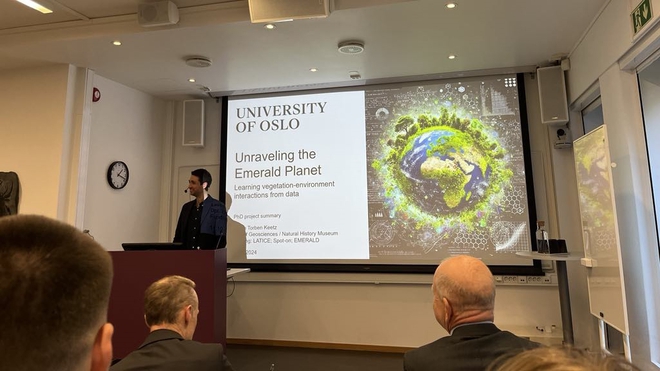
Lasse Torben Keetz's thesis makes significant advancements in the field of ecosystem modeling by integrating novel data and modeling approaches to better understand vegetation-environment interactions. Given the necessity of combining data from various sources collected through different methods, Keetz's work is crucial for improving our capacity for comprehensive ecosystem modeling.
The thesis is organized into three chapters:
Satellite data and machine learning in Ecosystem Distribution Models: In this chapter, Keetz investigates how satellite data, combined with machine learning techniques, can improve the performance of ecosystem distribution models. This study aims to enhance the accuracy and predictive power of these models in representing ecosystem distribution.
Land Sites Platform for CLM-FATES: The second chapter introduces the Land Sites Platform, a software tool developed to improve access to CLM-FATES (Community Land Model coupled with Functionally Assembled Terrestrial Ecosystem Simulator). This platform facilitates the use of CLM-FATES, making it more accessible and easier to apply for researchers working on land surface and dynamic global vegetation modeling.
Bayesian data assimilation for parameterization of CLM-FATES: In the third chapter, Keetz explores the potential of Bayesian data assimilation to refine the parameterization of CLM-FATES. By employing this probabilistic approach, the research aims to enhance the model's accuracy and robustness in simulating complex ecosystem dynamics.
Overall, Lasse Torben Keetz's work represents a meaningful contribution to ecosystem modeling, offering innovative tools and methodologies to better capture and understand the interactions between vegetation and environmental processes.