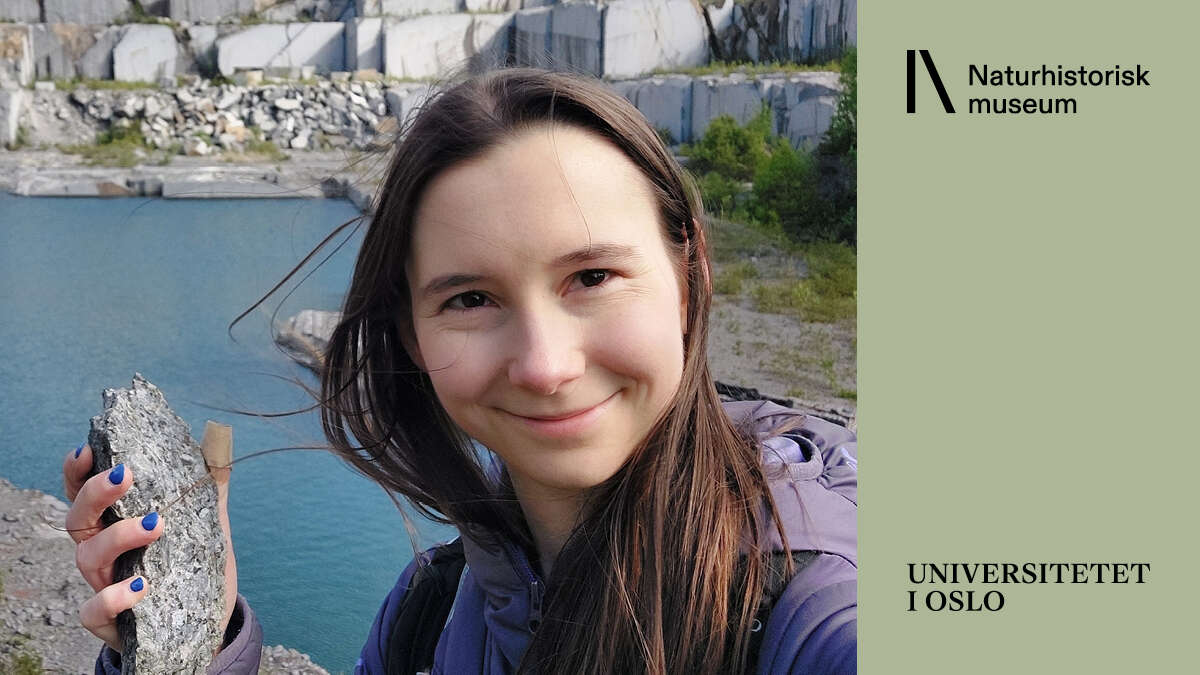
Trial Lecture
Title: "Perovskites - Strengths and challenges in high-tech applications"
Time and place: June 23, 2026, 10:15 AM, Tøyen hovedgård
Public Defence
Adjudication Committee
- Junior professor, Dr. Svenja Riedesel,Institute of Geography, University of Cologne, Germany
- Dr. Margret Fuchs, Helmholtz Institute Freiberg for Resource Technology (HIF), Germany
- Professor Hans Arne Nakrem, Natural History Museum, University of Oslo
Chair of the Defence
- Professor Micah Dunthorn, Natural History Museum, University of Oslo
Supervisors
- Professor Henrik Friis, Natural History Museum, University of Oslo
- Professor Adrian Anthony Finch, School of Earth & Environmental Sciences, University of St Andrews
Summary
Cryolite is a sodium, aluminium and fluorine mineral from Greenland. In recent years, materials based on the cryolite structure have been explored for applications in dosimetry and optics. These applications build on structural defects, which in cryolite are still poorly understood. Understanding them better is the aim of this thesis. To achieve this, natural cryolite is exposed to particle irradiation, ultraviolet and high temperature. These factors modify the defect structure, which is traced by an array of spectroscopic methods.
This work identifies four luminescence (light-emitting) centres and twelve centres that absorb light. The green luminescence centre is interpreted as an F-centre, where an electron occupies a missing anion site. The blue luminescence centres are interpreted as self-trapped excitons, electron-hole pairs trapped in the crystal structure.
Cryolite occurs in three colour varieties: white, purple and black, and their relation to defect structures is analysed. F-centres are connected with the purple colour. Black cryolite contains the same defects as other varieties, but higher concentrations, which favours clustering and suppresses light emission. We verify and reject the hypothesis about organic matter colouration. This work improves our understanding of how defects control colour in minerals and supports the development of new optical materials.
Contact