Det nye veksthuset ved Naturhistorisk museum
The New Greenhouse at the Natural History Museum
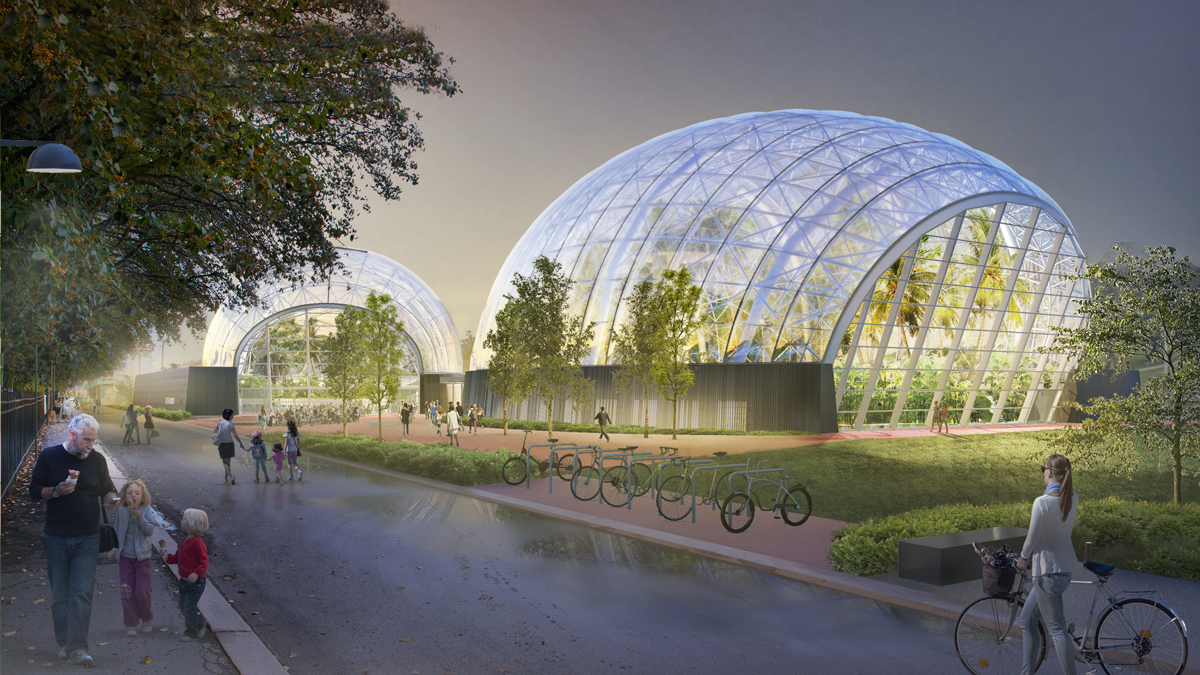
The Natural History Museum is actively working to realize the plans for a new greenhouse. The greenhouse will offer a breathtaking experience, and will play a key role in spreading knowledge about the climate and biodiversity crisis.
In a building totaling 5,000 square meters, visitors will experience naturalistic environments from five of the world's climate zones, ranging from deserts to tropical rainforests. In these living, breathing and growing exhibits, the public will learn about plants fundamental role in life on Earth, and how plants and climate mutually affect each other and create the conditions for human life. Here, you will be able to encounter over 2,000 species and observe how they change as you move from one climate zone to another.
In 2015, the Natural History Museum received funding for the new greenhouse at Tøyen. After completing the phase of preliminary planning and feasibility study, the project is now ready to be realized. With support from the Tom Wilhelmsen Foundation, the museum is moving into a new phase, actively working to secure the funds needed to build a greenhouse giving people a year-round experience of our planets amazing biodiversity.
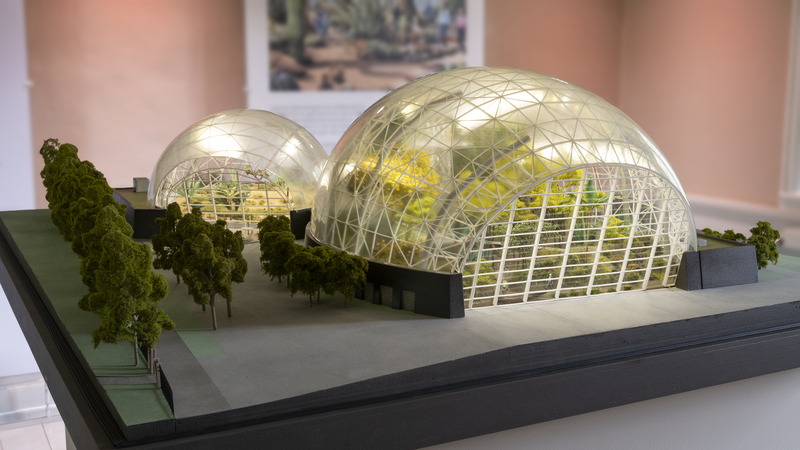
Visit the exhibition "Around the World at Tøyen"
The exhibition showcases the model and plans for the new Greenhouse. The public can visit the exhibition every day from 10 AM to 5 PM at Tøyen Manor (Tøyen hovedgård).
Watch the animation of the new Greenhouse
Why do we need a Greenhouse?
The Greenhouse fulfills a fundamental function in a botanical garden with a global perspective, and we are working hard to realize the building. The need for the Greenhouse has never been more relevant, as the world faces two human-made crises simultaneously: the biodiversity crisis and the climate crisis. These global challenges are interconnected, and to solve them, we must understand the seriousness and care deeply. The Greenhouse will become a national hub for knowledge about biodiversity and the conservation of endangered species, aiming to spark interest and inspire the preservation of nature. Therefore, the Greenhouse is an important initiative for the whole society.
Global Conservation of Plant Diversity
The world's natural areas and biodiversity are disappearing at an alarming rate, and for good. University communities around the world point to an urgent need for the conservation and further exploration of the world's plant diversity. This forms the backdrop for the project's stated goals and for the Norwegian Parlaments White Paper 4, Long-term Plan for Research and Higher Education 2019-2028. The white paper adheres to the UN's Sustainable Development Goals and asserts: "Through both education and research, universities and colleges are central to following up on the sustainability agenda."
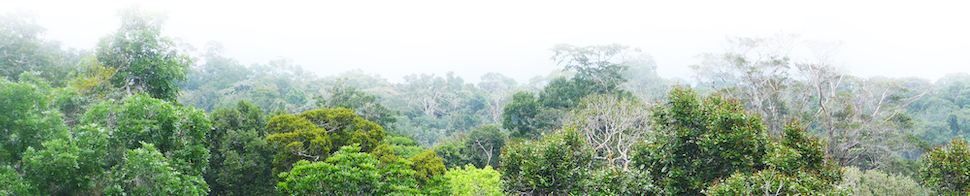
The Botanical Garden contributes to a global effort to preserve the world's plant diversity at a critical time. An analysis conducted by the international consortium of botanical gardens (BGCI) shows that the Botanical Garden's collections are unique and contain a high proportion of endangered species and scientifically well-documented, wild-collected material. However, most of the world's plant diversity is tropical. A hectare of Ecuador's rainforest has more than ten times as many tree species as all of Norway. Trees play a key role in the rainforest, both in themselves and as "climbing frames" for most of the rainforest's other plants. Therefore, we have designed a greenhouse that is large and tall enough to accommodate trees.
There is a great need for resource-rich countries like Norway to contribute to the conservation effort with living collections of endangered tropical plants. Although the museum has a long tradition of botanical research in the tropics, the lack of a greenhouse has prevented us from fulfilling such a role.
Research and Innovation
The last time we built a greenhouse for the public was in 1876 (the Victoria House). The need for a greenhouse now is different from that in the 19th century. New research fields and methods open the possibility for a deeper understanding of nature and how we can use plants in new ways as resources for food, medicine, chemicals, materials, and other beneficial purposes. The new research capacity also reveals how much is still unexplored regarding species diversity, their relationships, ecological connections, and vegetation's impact on the world's climate. The greenhouse's scientific plant collections from around the world, set in realistic growth environments, will constitute a new research infrastructure for the University of Oslo. This means that researchers can study the plants directly in the greenhouse. Through fieldwork and laboratory work, we seek answers about the plants—how they function, what role they play, how they are related, and what they can be used for, to name just a few. Fieldwork is often very resource-intensive and uncertain, especially when the plants grow in distant and hard-to-reach areas, and when one does not know in advance when the plants will bloom and bear fruit.
The Greenhouse will be a prop room of nature, streamlining existing research fronts and opening new ones. Here, researchers can constantly follow a vast number of species from distant regions and select exactly the material they need at the right time concerning blooming and fruiting. This can save researchers money, time, and carbon footprint. In some cases, the researcher will collect plant material to conserve it in the museum's herbarium or DNA bank. In other cases, the researcher will extract material to examine it in a laboratory or to cultivate it further under controllable conditions, either at the museum or at Blindern. In this way, the Greenhouse will streamline existing research at the Natural History Museum within taxonomy and systematics.
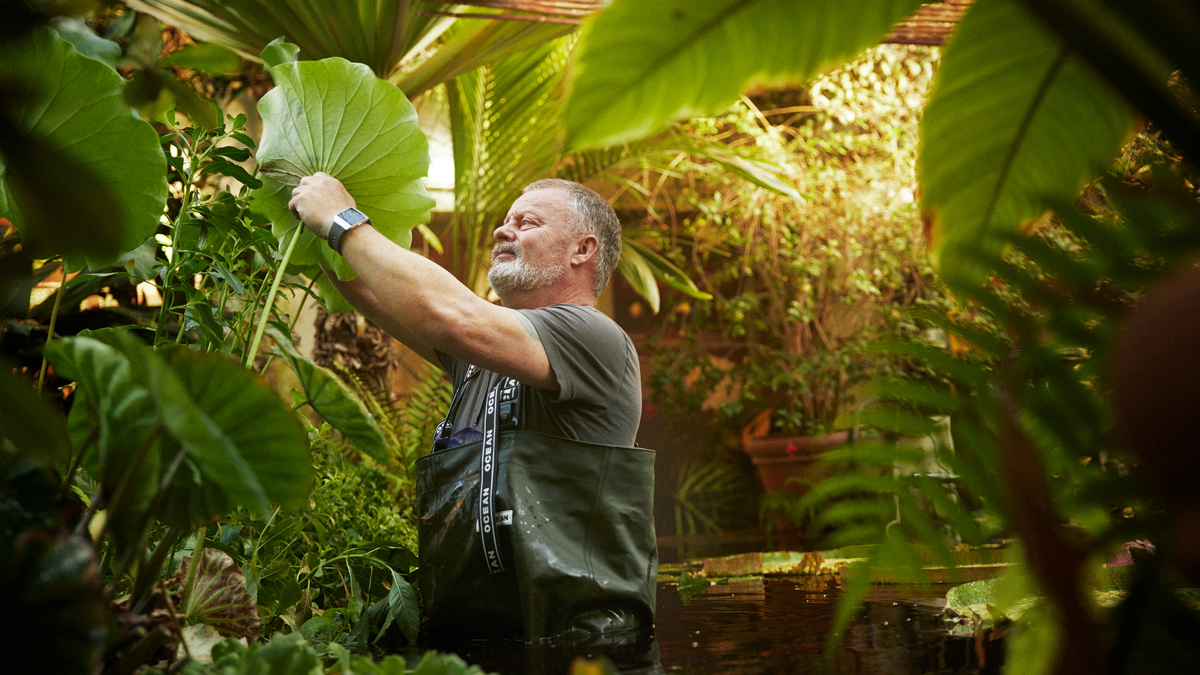
But the Greenhouse also opens up completely new opportunities. Many plants are impossible to move to a laboratory, but this does not make them any less important to study! For example, tropical trees and vines are relatively unexplored because they are so inconvenient to handle. They often grow in inaccessible places, and reaching the flowers and fruits, which are usually at the top, is difficult. Because we know so little about these plants, it is extra challenging to prepare for and succeed with fieldwork. In the greenhouse, it will be possible to perform investigations that would normally involve difficult fieldwork and uncertain outcomes. The greenhouse structure itself is like a climbing frame, making it easy to access any point in the display—whether for examining flower development, nectar production, scent compounds, or answering entirely different questions.
We therefore believe that the Greenhouse will help attract and develop academic communities and strengthen education and research at all levels.
Arena for Biodiversity
The world's biodiversity needs attention now, and Norway needs an arena to communicate this.
- Land plants constitute 80% of the world's biomass, but humans have halved it.
- Tropical rainforests cover 25% of the Earth's surface but house half of the world's plant species.
- 96% of global deforestation occurs in the tropics.
- In 2021, 111,000 square kilometers of tropical forest disappeared (equivalent to a third of mainland Norway's area).
- Wild mammals now make up 4% of the biomass of the world's mammals. The rest are humans (36%) and our livestock (60%).
- The biomass of the world's wild vertebrates has decreased by 60% from 1970 to 2014.
- Fragmentation of nature prevents plants and animals from migrating in response to climate change. This will enhance species extinction in the coming years.
We are facing a collapse of the world's biodiversity, but it is not enough for researchers to acknowledge this. Only when a large proportion of the population understands the seriousness do we have a chance to do something about it. Therefore, we need an where people can get engaged, learn about, and discuss global botanical diversity. This is the role the greenhouse is designed to fulfill. The collections make the greenhouse a unique place for the intersection of research and the public, a necessary function to create understanding and interest among the population and to stimulate new generations of researchers and nature enthusiasts.
The Natural History Museum is a central learning arena for schools in the Oslo region. The Climate House has strengthened and expanded this function. The Greenhouse will further strengthen, expand, and update its role as a learning arena by being a place where students can develop an interest in and learn about biodiversity. Schools are the most important target group for the project. With five climate zones distributed across four rooms, as well as laboratories and teaching rooms, the greenhouse will have the capacity for 20 school classes per day with programs lasting 1.5-2 hours.
Technology for Green Transition
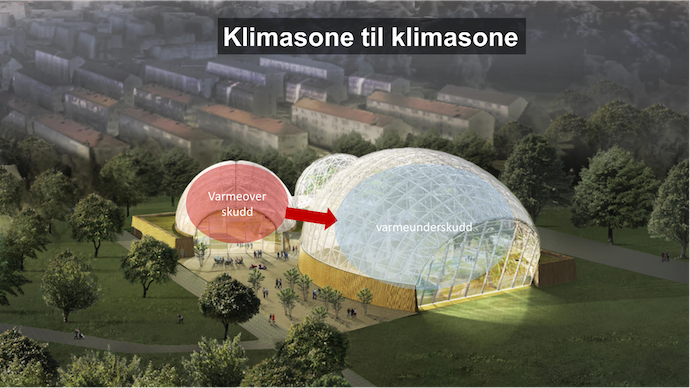
Electric energy can be used for almost anything and thus has a very high energy quality. Moderate heat, on the other hand, represents the lowest energy quality. An unduly large amount of the high energy quality that Norway has in abundance is used for heating buildings. According to the Norwegian Water Resources and Energy Directorate (NVE), energy efficiency improvements in the building stock can free up 13 TWh of electricity profitably, even at an electricity price of 1 NOK/kWh. Some believe the potential is much higher. The Greenhouse's climate and energy technology are pioneering work and point the way forward. By harvesting, storing, and distributing clean thermal energy within the building structure, the need for supplied energy for heating (electricity or district heating) is reduced by about 80%. The solutions partly build on knowledge and production methods from the offshore industry and have significant transfer value to other types of buildings. Implementation will be a concrete contribution to the green transition and enhanced industrial competitiveness. The government wants Norway to be a leading country in renewable energy, and the white paper asserts: "a large part of the transition to a low-emission society must be related to the production and use of energy."
The five climate zones of the Greenhouse

Tropical rainforest
In order to showcase the enormous diversity of tropical rainforests, this department will be the largest and tallest of the five climate zones presented. We will display the layered growth zones of rainforests, from the undergrowth to the tips of the canopy and what distinguish the different layers. The canopies – and the plants growing in them – will shade the bottom resulting in a dark and realistic undergrowth. While strolling among tree roots and the undergrowth, look up and you will observe a sea of green foliage. Not many greenhouses have accomplished this, but we are positive that we will succeed.
Tropical cloud forest
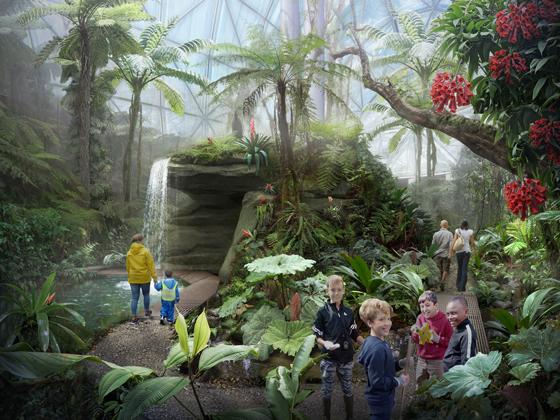
The tropical cloud forests are dripping wet, even more so than the rainforests, yet cooler. These forests cover mountain slopes of South and Central America, Southeast Asia and some regions of Africa. They are often important water sources for their surrounding lowlands. Ferns, trees coated with mosses and orchids, together with flowing water, create a unique environment for you to explore. Tropical cloud forests threatened in many places of their distribution. Climate change pushes cloud formation higher up, so that the forests become fragmented or disappear altogether, something we wish to bring extra attention to.

Mediterranean
The Mediterranean climate is well-known and well liked, and is present on several continents, despite its name. Many of our cultivated plants have their origin in this climate, including olives, figs and a range of familiar spices and plants used as perfumes. There will be a café in this part of the exhibition, in which our gest will be able to enjoy the taste of many of the very plants that surrounds them.

Desert
Under the same dome as the Mediterranean climate there will also be a desert department. All Mediterranean climates border desert regions so they naturally belong close together in the display. Desert pant often have spectacular adaptations to their harsh conditions, ranging from tiny camouflaged living "rocks" to giant "cowboy cacti" (saguaro).

Artcic
The arctic display will not be a regular greenhouse but more like a 80 square meter growth chamber. Light conditions, temperature and humidity will be controlled independently from the seasons outside. This allows us to speed up the seasons so that we can display two summers and two winters annually. We wish to show our visitors how the plants interact with their extreme polar environment and each other. Some species turn their satellite dish shaped flowers with the movement of the sun, which in the arctic has a very low angle. In order to display this we will build a unique and customizable light design.
Kontakt
Har du spørsmål om det nye veksthuset som planlegges på Naturhistorisk museum?
Ta kontakt med prosjektkoordinator Finn Ervik:
- TLF: +47 22 85 18 26
- Epost: finn.ervik@nhm.uio.no