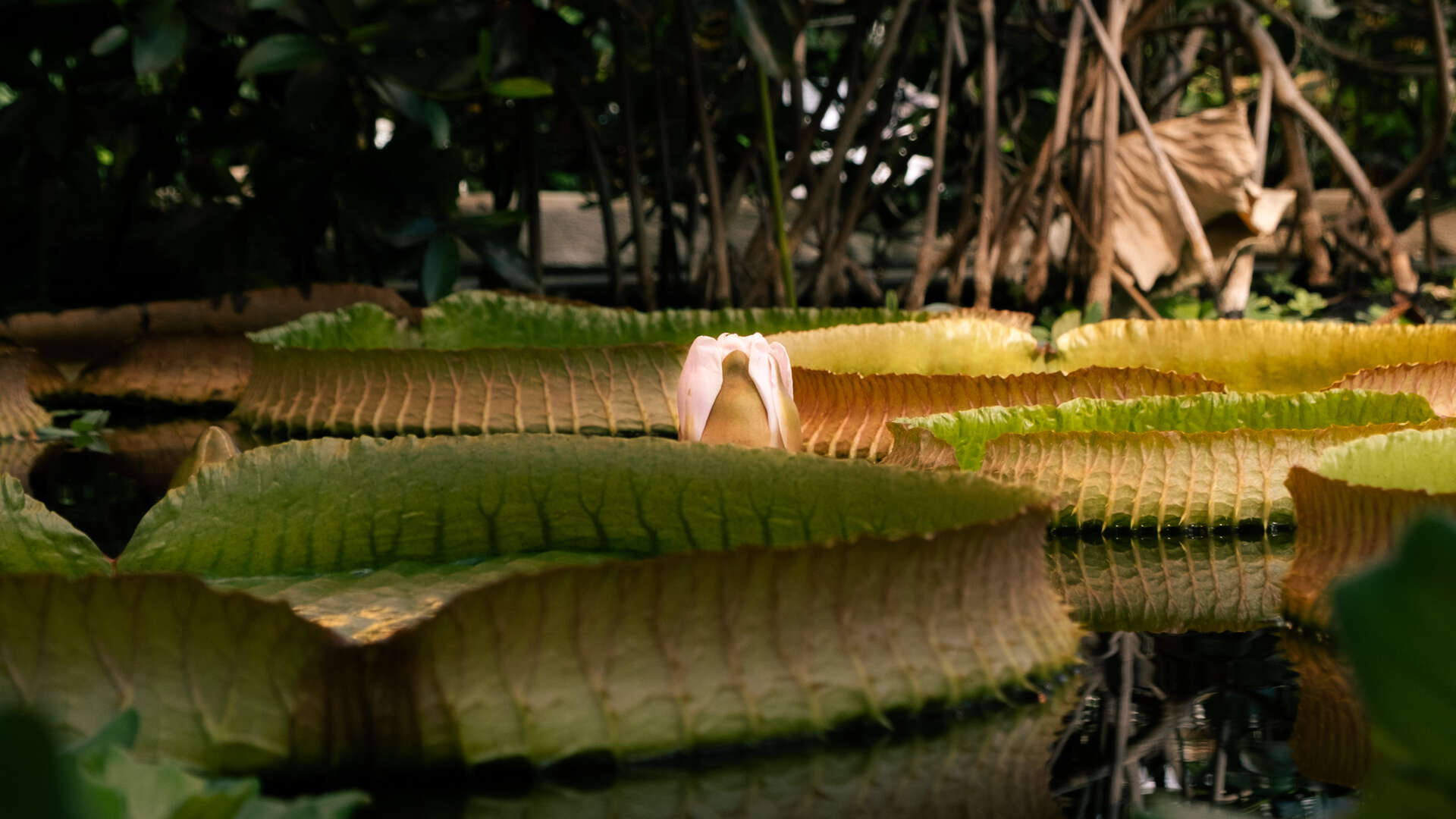
The three species
Victoria amazonica
The species was formerly called Victoria regia. It is native to the Amazon and Orinoco. The floating leaves reach up to 2.7 metres in width. The flowers have around 50 petals and can grow to more than 40 centimetres across. The species has occasionally been cultivated in the Victoria House, but is less suitable than Victoria cruziana.
Victoria cruziana
The species grows in the Paraná River, which runs through Brazil, Paraguay and northern Argentina. It has slightly smaller flowers and leaves than the other two, but a higher leaf rim. Victoria cruziana tolerates slightly cooler water and is easier to grow in a greenhouse. In addition, it flowers more often than the other two species. This is the species we most often cultivate in the Victoria House.
Victoria boliviana
The species is native to Bolivia, where it grows in wetlands connected to the Amazon. Amazingly, it was only described in 2022. The leaves can reach up to 3.2 metres in width and are the largest in the genus. We have never had this species in the Victoria House, and due to its size it will never be able to grow here.
There are several hybrids between Victoria amazonica and Victoria cruziana that are used as ornamental plants in tropical regions and in greenhouses.
The flowering of the Victoria water lily
The flowers open on two consecutive nights and are closed during the day. On the first night, the flower is white and in the female phase. The next night it is reddish and in the male phase, when it releases the pollen. The flower raises its temperature by several degrees, which helps spread the scents that attract the beetles that pollinate the flowers.
The flower opens on two consecutive nights, but stays closed during the daytime between the two nights. On the first night, the flower is pure white. On the second night, it changes colour. It starts out pink in the centre, and this colour gradually spreads over the petals.
Why this two-step flowering, and why exactly two nights? Why not one, or three? Why does it close during the day? The explanation came when the plant was studied in the wild.
Flowers are reproductive organs, and the Victoria flower is, like many other flowers, bisexual. It can pollinate itself and even produce viable seeds, but plants, too, try to avoid inbreeding. Flowering on two consecutive nights promotes cross-pollination and makes self-pollination less likely.
The Victoria water lily is pollinated by a species of rhinoceros beetle (a type of scarab). They are attracted to the Victoria flower on the first night by a kind of advertisement and payment. The most important advertisement is scent. This is typical of night-flowering plants, because scent works just as well in the dark. The molecules spread especially well when they are warmed up (think of the smell from a bakery!). A chemical process in the Victoria flower provides exactly that. On the first night, the centre of the flower is about 10 degrees warmer than its surroundings. The advertising poster is the pure white petals, which reflect the faint light and make the flower visible to the flying beetles. For them, the flower is both restaurant and dating venue. They gather there to feed on the starchy plant tissue around the ovary and to mate.
Unnoticed, the flower demands a service in return for providing the arena for this beetle orgy: efficient cross-pollination. On the first night, only the female parts of the flower, the ovary with the stigma, are mature. The stigma secretes a fluid that washes off the pollen that the beetles are covered in from visits to other flowers.
When morning comes, the flower closes around the beetles and protects them from scorching sun and predators (especially jacana birds, a type of lily-trotter). The male parts of the flower, the anthers, now open and shower the beetles, which are crowded together inside the flower, with pollen.
When night falls again, the flower opens for the second time. The beetles are released, covered in pollen, and what do they do? They look around for a new, pure white, warm, fragrant Victoria flower that is open for the first time, ready to receive them.
On the second night, the flower is no longer attractive to rhinoceros beetles. It produces little scent and has changed colour, making it less visible. After the beetles’ activities, it also looks rather bedraggled. Nevertheless, the flower warms up as the night progresses. This probably helps the large beetles to take off and fly. If the flower is not visited by rhinoceros beetles, it can play its trump card: mature pollen falls down into the centre of the flower and gives rise to seeds.
When we have had Victoria amazonica in the Victoria House, this is what has happened. We have obtained seeds through self-pollination, and thus had the opportunity to grow the plant again. In flowers that have been pollinated and fertilised, seeds develop under water inside the spiny ovary. As the seeds ripen, they are released. Seeds of tropical plants often have a short shelf life and germinate quickly.
Victoria seeds, however, have the highest germination rate after 1–2 years. The plant grows in still water, but over such a relatively long period the seeds can be carried some distance by weak currents. The longevity of the seeds and their slow germination can therefore prevent local “overpopulation” and help ensure that the species spreads.
The hybrid between Victoria amazonica and Victoria cruziana that is currently growing in the Victoria House does not produce seeds (the two species have different numbers of chromosomes, and the offspring is a sterile hybrid).
The incredible speed of leaf growth
The leaves of the Victoria water lilies are among the fastest-growing in the world. The diameter of a leaf can increase by 35 cm in a single day. By comparison, a small birch leaf the size of a fingernail takes a week to unfold. In the wild, the plants grow in nutrient-rich river mud. In the Victoria House, they need a lot of fertiliser to maintain this vigorous growth.
Growing the Victoria water lily
The enormous leaves of the Victoria water lily made a strong impression on the first Western explorers who saw them in the 19th century. Naturally, they could not bring the plants home to Europe in their suitcases, and the plants could not be pressed into neat herbarium specimens either. Seeds, however, they could carry or send, and from the 1840s experiments were made with growing Victoria plants in pools and ponds in various places, especially in England. Sometimes the seeds germinated, but they produced only a few small leaves, and then died. Joseph Paxton in England was the first to succeed.
- It is still a demanding plant to cultivate today:
- It needs a high, stable temperature.
- The water in the pool in the Victoria House is thermostat-controlled at 28°C.
- It needs lots of fertiliser.
- The air humidity must be high.
- The air temperature likewise.
- It needs a lot of light.
Achieving all this in the 1840s, in overcast England, with coal heating, no thermostats, and glasshouses with tiny panes and thick iron beams that cast a lot of shade, was truly an achievement, and it took time before Paxton succeeded.
Paxton’s great “invention” was the greenhouse. He designed the famous Crystal Palace in England, and a number of other renowned glass “conservatories”, as they were called. Throughout his life, he experimented with glass structures, larger glass panes, thinner beams and new materials. It is said that one of his most important sources of inspiration was the leaf of the Victoria water lily. The underside of the leaf is in fact a fantastic network of air-filled veins that gives the leaves strong buoyancy. It is like lining a small boat with foam plastic – it becomes almost impossible to sink it.
Many people have seen photos of children sitting on a Victoria leaf. The condition is that the weight is evenly distributed over the surface of the leaf. A small child can sit on the leaf with legs crossed, but an older child must stand or sit on a board to distribute the weight.
The network of air-filled veins and the high leaf rims mean that the leaves can withstand a great deal of weight. It was the distribution of weight in the leaf’s construction that is said to have inspired Paxton in his work to devise a network of thin supporting beams capable of bearing the weight of a glasshouse while casting as little shade as possible.
The Victoria water lily was a sensation with the public from the very beginning, and people flocked to see it. Botanical gardens all over Europe built Victoria houses based on Paxton’s ideas. There is a Victoria house in Stockholm, in Helsinki, in Kew Gardens in England, and in a number of other places. The Botanical Garden in Oslo also acquired its own Victoria house. This house was opened in 1876, and since 1879 we have been cultivating Victoria water lilies here.
Victoria regia – an old name for a royal plant
Thaddäus Haenke was probably the first European to see and describe a Victoria water lily, in 1801, but it took a long time before the plant was collected for a herbarium and given a scientific name.
The first Victoria species to be described was Victoria amazonica, but that was not its first name.
In 1837, John Lindley gave it the name Victoria regia. Both the newly established genus name (Victoria) and the species epithet (regia) honoured Queen Victoria of England (1819–1910) – regia means “royal”. So why was that not acceptable? Why did the name have to be changed?
It turned out that Eduard Friedrich Poeppig had already given the plant the name Euryale amazonica in 1832. This was the species’ first scientific description and its very first name, but Poeppig had placed it in the already existing genus Euryale. According to the rules for scientific names, the oldest name must always be used. However, since the plant in fact belonged in the newly established genus Victoria and not in Euryale, it was moved to Victoria but retained its species epithet, amazonica. Thus its correct name became Victoria amazonica.
It has turned out that the name Victoria regia has not been so easy to forget, and people still come to see “Victoria regia” in botanical gardens, several generations after the name change.
In Norway, the name has perhaps become especially firmly rooted because of Johan Borgen’s short story “Victoria Regia” (1954), in which the Victoria House, with its warm, humid climate and the flowering giant water lily, is the setting for an erotically charged encounter between two strangers. The last sentence of the story reads: “Victoria regia smiled slyly in the dusk.” With such strong literary associations, it is perhaps not so strange that the name lives on.